
Erasmus+ is a great opportunity to experience and live in a new country, discover a new culture, and learn a new language. However, people rarely associate it with mental health struggles. Even though mental health difficulties do not suddenly disappear when you are learning a new language and adapting to a new culture and country, these circumstances can actually make them more apparent. You are away from what you know and outside of your comfort zone.
I am an Erasmus+ alumna and, whilst I had many positive experiences that contributed to my personal development, I also witnessed some negative experiences. However, there was nothing in comparison to the experiences of other volunteers who were part of the same volunteer group. Without going into too much detail, their Erasmus+ experience was not the best, which then had an emotional impact on the whole group of volunteers.
At that time, I had no experience in psychological interventions, but I was passionate about social justice, so I took it upon myself to advocate for them. I went above and beyond to ensure that their voices were heard that action was taken, and that support was put in place. Eventually, they received the support they deserved. However, there was no mental health or emotional support available, either for them or for the others around them. The only support in place came from fellow volunteers who provided informal emotional support.
I also had a friend who was doing Erasmus+ in the same country, and he did not particularly enjoy his experience because he did not get along with his Erasmus+ managers. As a result, he spent much of his Erasmus+ placement in a low mood. During my time in Erasmus+, I do not recall there being a dedicated member of staff responsible for supporting volunteers’ emotional or mental wellbeing. There were, however, many volunteer managers and assistants, around seven in total.
The following are some of the difficulties that volunteers can face during Erasmus+ which may exacerbate existing mental health difficulties:
These are just some of the circumstances that can negatively affect the overall experience. I believe it is crucial to have a dedicated member of staff available to support volunteers with their mental health. Someone who is there to listen without judgement and provide guidance. Mental health difficulties do not disappear simply because you are taking part in Erasmus+.
I think it is also important to recognize that many volunteers put themselves forward to Erasmus+ programmes, despite already living with mental health difficulties, we should honor that effort by providing specialized support so that Erasmus+ becomes truly inclusive for all volunteers.
This is also why I believe it is important to develop and test mental health support that young people can access in a way that fits their lives. Through YOUTHreach, young people are being invited to take part in research exploring different accessible approaches to supporting youth mental health. Recruitment is taking place in several European countries, offering young people the opportunity to contribute to research while accessing support that is designed with their needs and experiences in mind. Young people’s participation is essential to understanding what works, for whom, and in which circumstances, and to making mental health support more inclusive and accessible.
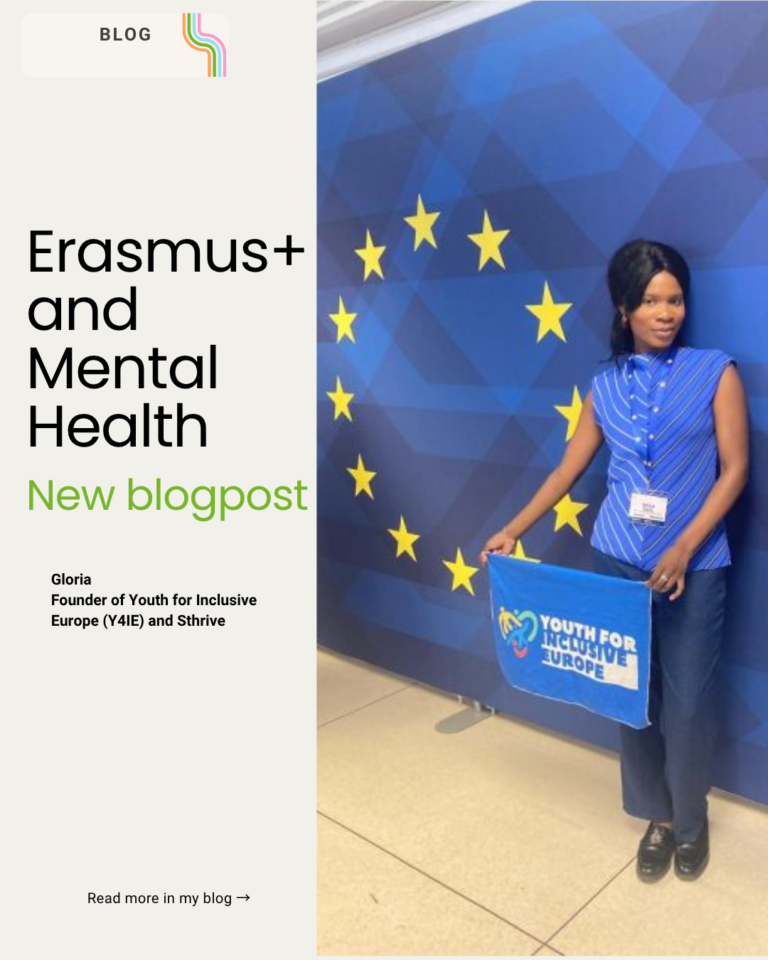
I am Gloria, the Founder of Youth for Inclusive Europe (Y4IE), a civic organization that aims to empower young people to advocate for more inclusive policies across the EU. We do this through research, which then informs our campaigns. My academic background is Psychology, and I believe that social justice and psychology go hand in hand. I am also a tech Start up; I’m the founder of Sthrive, a student wellbeing company building an app that supports students while they wait for mental health care, alongside software that helps university wellbeing teams manage waiting lists, follow-ups and outcomes.
Find the latest YOUTHreach updates in your inbox!